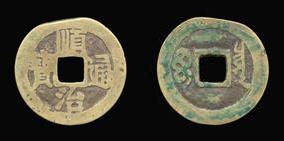
C268B__0 Shih Tsu (1643-1661)
Period: Shun Chih (1643-1661)
Mint: Peking, Board of Public Works
O
Coinage of Obedient Rule
SHUN CHIH TUNG PAO
R
Peking, Board of Public Works
BOO [in Manchu left] YUWAN [Board of Public Works] [in Manchu right]
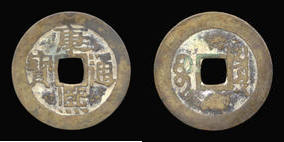
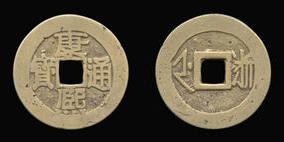
C269A__0 Sheng Tsu (1661-1722)
Period: Kang Hsi (1661-1722)
Mint: Peking, Board of Revenue
O
Coinage of Steady Prosperity
KANG HSI TUNG PAO
R
Peking, Board of Revenue
BOO [in Manchu left] CIOWAN Board of Revenue] [in Manchu right]
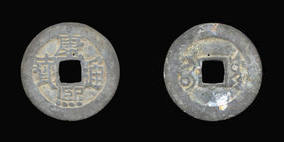
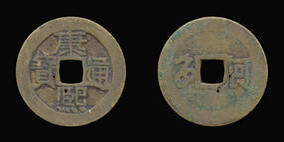
C269A__1 Sheng Tsu (1661-1722)
Period: Kang Hsi (1661-1722)
Mint: Peking, Board of Public Works
O
Coinage of Steady Prosperity
KANG HSI TUNG PAO
R
Peking, Board of Public Works
BOO [in Manchu left] YUWAN [Board of Public Works] [in Manchu right]
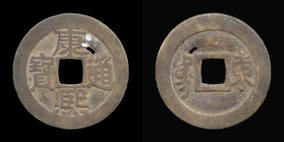
C269B__2 Sheng Tsu (1661-1722)
Period: Kang Hsi (1661-1722)
Mint: Chi-Chow, Chihli
O
Coinage of Steady Prosperity
KANG HSI TUNG PAO
R
Chi-Chow, Chihli
JU [in Manchu left] CHI [in Chinese right]
C269B__0 Sheng Tsu (1661-1722)
Period: Kang Hsi (1661-1722)
Mint: Ho-nan
O
Coinage of Steady Prosperity
KANG HSI TUNG PAO
R
Ho-nan
HO [in Manchu left, in Chinese right]
C269B__1 Sheng Tsu (1661-1722)
Period: Kang Hsi (1661-1722)
Mint: Shang-Tung
O
Coinage of Steady Prosperity
KANG HSI TUNG PAO
R
Shang-Tung
DUNG [in Manchu left] TUNG [in Chinese right]