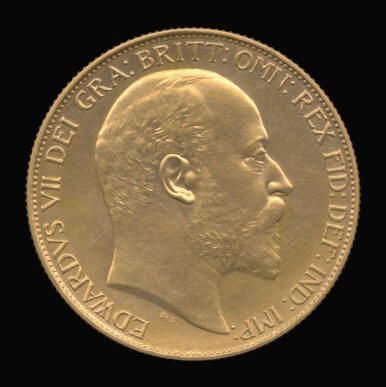
1902 Double-Pound
His coronation was the 9th of August 1902 and there were two proof sets issued with that date. The first
was a long set consisting of five pounds, two pounds (pictured here), sovereign, half-sovereign, crown,
halfcrown, florin, shilling, sixpence, Maundy Set (four coins). The second, short set, was issued which
contained all of the preceding with the exception of the five- and two-pound pieces. There were a total
of 15,123 proof coins (of each denomination from the sovereign down to the Maundys) struck in 1902.
There were 8,066 struck of the five- and two-pound coins. Of interest is that for the first time, the
proof coins were struck in Matt style rather than the polished style. This gives the coins a dull finished look.
Gold coins were struck not only in London, but also in Ottawa, Sydney, Melbourne, and Perth. See
here for the mintmarks used and for their locations on
the coins. A third-farthing coin was struck for use in Malta, and is included in standard references of the
coins of England and Great Britain. Two styles of bronze penny and halfpenny were struck. A normal tide version
which continued for the rest of the years of the reign, and a much rarer low-tide variant which was struck
only in 1902. See here to learn how to differentiate
between normal and low-tide coins.
Monarchs of England and Great Britain | Coins of England and Great BritainEdward VII of Great Britain (1902-1910)
1902 Double-Pound
Albert Edward, later Edward VII, was born on the 9th of November in 1841. He was the oldest son of his
predecessor, Queen Victoria. He was married to the Princess Alexandra of Denmark on the 10th of March
1863, with whom he had three sons and three daughters. Two of his sons died before him, Albert Victor,
his first born, on the 14th of January 1892 at the age of 28, and Alexander John, the third son, who died
on the 7th of April 1871 at the age of one day. Edward VII died on the 6th of May in 1910 and was
succeeded by his oldest surviving son, who became George V.